
When One Diagnosis Doesn't Explain Everything
Understanding the Learning Disabilities, Developmental Differences, and Co-Occurring Conditions That Commonly Overlap with ADHD and Autism

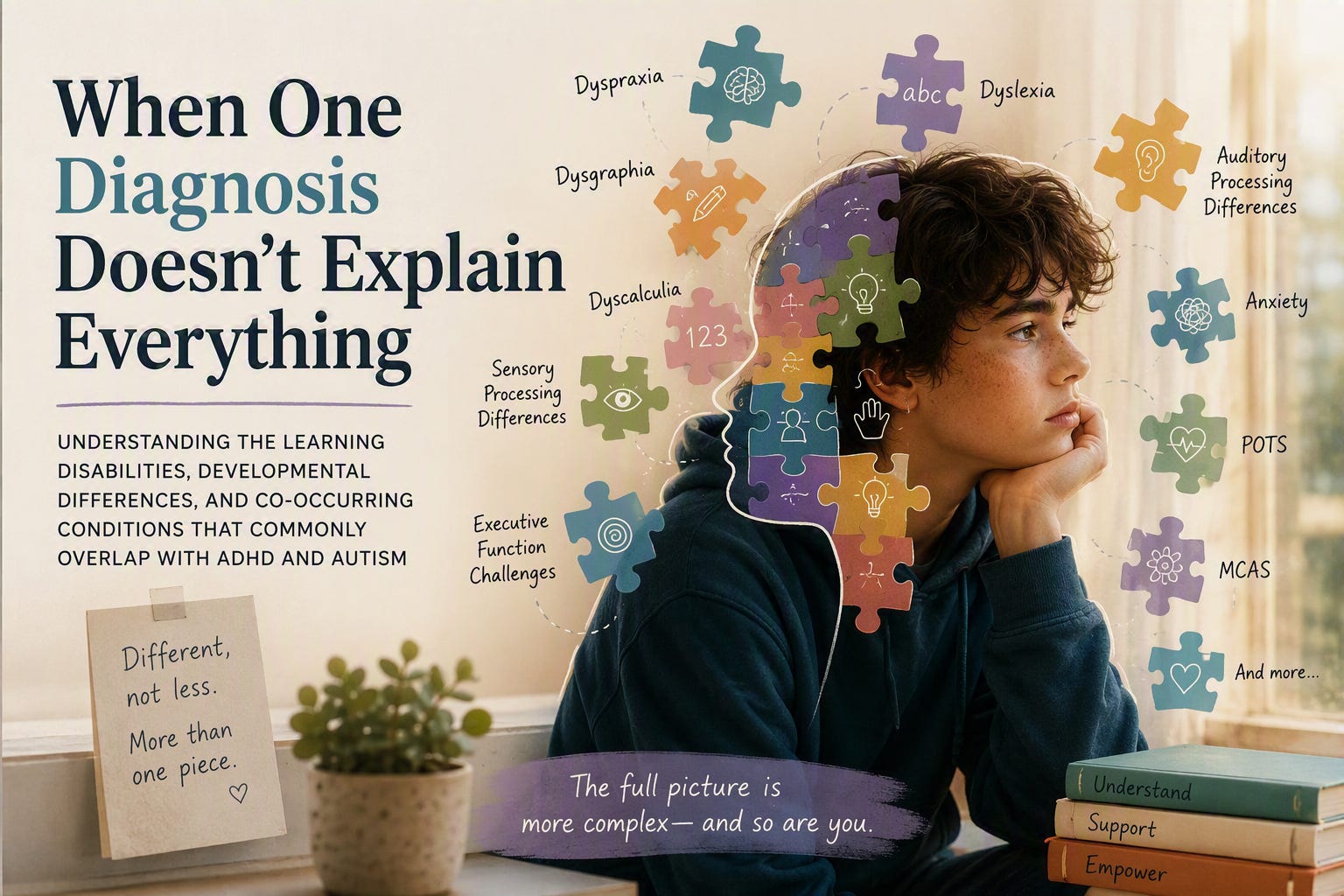
After posting my last article on the vestibular system, some of you beautiful humans who read my content commented on other diagnoses and challenges that often co-exist at higher rates in neurodivergent populations. Given my experience with some of the challenges personally and others through my clients, I recognize a massive information void in this space. Where there is a knowledge gap, there is an opportunity to bridge it, which is what this article aims to promote.
When most people think about neurodivergence, they often think primarily of autism or ADHD. While these are two of the most recognized neurodevelopmental conditions, they rarely exist in isolation. In reality, many neurodivergent individuals have multiple overlapping conditions, learning disabilities, sensory differences, and developmental profiles that interact with one another in complex ways.
For many late-diagnosed adults, receiving an autism or ADHD diagnosis is only the beginning of a much larger journey of self-understanding. It is not uncommon to discover that challenges previously attributed to one condition are actually influenced by another. Difficulties with handwriting, coordination, mathematics, reading, organization, sensory processing, or communication may have roots in co-occurring conditions that were never recognized.
Understanding these overlaps is important because it provides a more complete picture of how neurodivergence shows up in everyday life. It can also help explain why two people with the same diagnosis may have dramatically different experiences, strengths, and challenges.
The Myth of the Single Diagnosis
One reason co-occurring conditions are often overlooked is that people tend to think in categories. When it comes to neurodivergence, categorization often looks like “person A is autistic”, or “person B has ADHD,” or “person C has dyslexia”. The reality is usually much messier and significantly more complex.
Neurodevelopmental conditions frequently overlap, and many of the same genetic, neurological, and developmental factors appear to influence multiple conditions. Rather than existing as completely separate categories, they often intersect and interact with one another. As a result, many neurodivergent individuals find that a single diagnosis explains only part of their experience. The remaining pieces often begin to make sense when additional conditions are considered.
Dyspraxia: The Coordination Difference Often Mistaken for Clumsiness
Dyspraxia, also known as Developmental Coordination Disorder (DCD), is one of the most commonly overlooked co-occurring conditions in neurodivergent populations. People with dyspraxia often experience challenges related to motor planning, coordination, balance, timing, and movement. They may struggle with tasks that require precise physical control or pressure, such as handwriting, sports, driving, using tools, or learning new physical skills.
Many adults with dyspraxia spent years being described as clumsy, awkward, careless, or uncoordinated. They may have avoided sports throughout childhood or felt embarrassed by tasks that seemed easy for others. When dyspraxia occurs alongside autism, ADHD, or AuDHD, it can amplify difficulties with daily living and contribute to increased fatigue. Many people are surprised to discover that challenges they assumed were personal failings actually stem from how their brain plans and executes movement.
Dyslexia: More Than Reading Difficulties
Dyslexia is often reduced to a reading disorder, but the reality is far more nuanced. While dyslexia does affect reading accuracy and fluency, it can also influence spelling, language processing, working memory, information retrieval, and rapid word recognition. Many dyslexic individuals are highly intelligent and creative but require different approaches to processing written information.
Because Dyslexia frequently co-occurs with ADHD, some individuals experience difficulties related to both attention regulation and language processing. This combination can make learning environments particularly challenging. Many late-diagnosed adults report years of believing they were less capable than their peers despite possessing significant strengths that conventional education systems failed to recognize.
Dysgraphia: When Thoughts Move Faster Than Hands
Dysgraphia affects the ability to write and express ideas through written language. It can involve difficulties with handwriting, spelling, organization of written thoughts, fine motor control, and the physical act of writing itself. For some individuals, dysgraphia creates a frustrating gap between their intellectual abilities and their ability to get those ideas onto paper. They may know exactly what they want to say but struggle to organize or physically produce the written output.
Because many educational systems place heavy emphasis on writing, dysgraphia can have significant effects on academic confidence and self-esteem. When dysgraphia co-occurs with ADHD or autism, it can be particularly difficult to identify because challenges are often attributed solely to attention or executive functioning difficulties.
Dyscalculia: The Often Forgotten Learning Disability
While dyslexia receives increasing public awareness, dyscalculia remains relatively unknown despite being equally impactful. Dyscalculia affects mathematical reasoning, number sense, sequencing, and understanding numerical relationships. Individuals may struggle with basic arithmetic, estimating quantities, managing time, following sequences, or understanding concepts related to measurement and finance.
Many adults with dyscalculia describe feeling intense shame about mathematical tasks because their difficulties were interpreted as a lack of intelligence or effort. In reality, dyscalculia represents a distinct difference in how numerical information is processed. Like other learning disabilities, it has nothing to do with overall intellectual disability.
Auditory Processing Differences
Some neurodivergent individuals experience auditory processing differences, which affect how the brain interprets spoken language and sounds. A person may hear perfectly well but struggle to process verbal information quickly, especially in noisy environments. They may frequently ask others to repeat themselves, mishear instructions, or require extra time to interpret conversations. These experiences can be mistaken for inattentiveness, hearing loss, or lack of interest when the actual issue lies in how auditory information is processed by the brain.
Hypermobile Conditions and Chronic Health Challenges
An emerging area of discussion involves the increased prevalence of certain physical health conditions within neurodivergent populations. Many autistic and ADHD individuals report experiences with hypermobility, chronic pain, fatigue, autonomic nervous system dysfunction, gastrointestinal issues, migraines, and connective tissue disorders. While research in this area is ongoing, many neurodivergent adults find validation in recognizing that their experiences often involve both neurological and physical components. The relationship between neurodevelopment and physical health is increasingly recognized as more complex and interconnected than previously understood.
POTS: When Standing Up Feels Like Running a Marathon
Another condition that appears to occur at higher rates within neurodivergent populations is Postural Orthostatic Tachycardia Syndrome (POTS), a form of autonomic nervous system dysfunction that affects how the body regulates heart rate, blood pressure, and circulation. People with POTS often experience symptoms such as dizziness, lightheadedness, rapid heart rate, fatigue, brain fog, exercise intolerance, and difficulty remaining upright for extended periods. Something as simple as standing up, taking a shower, or walking across a room can place significant demands on the body.
For many neurodivergent individuals, POTS can complicate an already complex picture. Symptoms such as difficulty concentrating, fatigue, sensory overwhelm, and executive functioning challenges may become more pronounced when the body is struggling to regulate blood flow and energy effectively. Because POTS symptoms are often invisible, individuals may spend years being told they are anxious, out of shape, or simply not trying hard enough. A proper understanding of dysautonomia can bring significant validation to people who have long known that their physical exhaustion felt different from ordinary tiredness.
As awareness of neurodivergence continues to grow, increasing attention is being given to the overlap between autism, ADHD, hypermobility, and autonomic nervous system disorders such as POTS. While researchers are still exploring these connections, many neurodivergent adults report recognizing their own experiences within this overlap.
MCAS: When the Immune System is Constantly on High Alert
Mast Cell Activation Syndrome (MCAS) is another condition that is increasingly discussed within neurodivergent and hypermobile communities. Mast cells are immune system cells involved in allergic and inflammatory responses. In people with MCAS, these cells may release chemicals inappropriately or excessively, triggering a wide range of symptoms.
MCAS can affect multiple body systems and may present through symptoms such as skin reactions, gastrointestinal issues, headaches, flushing, allergic-type responses, respiratory symptoms, fatigue, and neurological complaints. Because symptoms can vary significantly from person to person and may fluctuate over time, obtaining recognition and diagnosis can be challenging.
For neurodivergent individuals, MCAS can add another layer of complexity to daily life. Sensory sensitivities, food-related difficulties, chronic fatigue, and unpredictable physical symptoms may interact in ways that make functioning more difficult. Some individuals describe feeling as though their bodies are constantly reacting to an environment that others seem to be able to tolerate without difficulty.
Like many co-occurring conditions, MCAS is often misunderstood or dismissed, particularly when symptoms do not fit neatly into a single medical category. As awareness grows, many people are beginning to recognize how interconnected neurological, immune, and autonomic nervous system functioning can be. For some late-diagnosed adults, learning about MCAS helps explain years of seemingly unrelated symptoms that never fully made sense when viewed in isolation.
Why Recognition Matters
Understanding co-occurring conditions is not about collecting labels. It is about creating a more accurate understanding of how an individual functions. Many people spend years trying to address challenges using strategies designed for only one aspect of their neurodivergence. When additional conditions go unrecognized, these strategies may provide only partial relief or completely fail.
Recognition allows for greater self-compassion. It helps explain why certain difficulties persist despite effort and why traditional approaches may not always work. Most importantly, it shifts the conversation from personal failure to neurological difference.
The Importance of Looking at the Whole Person
One of the most significant lessons emerging from neurodiversity research and lived experience is that neurological differences rarely exist in isolation. Conditions such as autism, ADHD, dyslexia, dyspraxia, dyscalculia, POTS, MCAS, hypermobility, sensory processing differences, and executive functioning challenges often overlap in complex and highly individualized ways. Understanding these intersections allows for a more complete picture of a person’s experiences. Rather than viewing challenges as separate, unrelated problems, it becomes possible to see how different systems of the body and brain may be influencing one another.
For many neurodivergent adults, this broader perspective can be profoundly validating. It shifts the question from “What’s wrong with me?” to “How do all these pieces fit together?” That change in perspective can be the beginning of a much deeper and more compassionate understanding of oneself.
Summary
Neurodivergence is rarely confined to a single diagnosis. Many autistic, ADHD, and AuDHD individuals also experience co-occurring conditions such as dyspraxia, dyslexia, dysgraphia, dyscalculia, POTS, MCAS, etc., with overlapping differences that often shape daily experiences in ways that are not immediately obvious. Understanding these interactions provides a more complete and compassionate picture of what it means to be neurodivergent.
Concluison
One of the most powerful aspects of a neurodiversity-informed perspective is recognizing that human brains do not fit neatly into diagnostic boxes. The reality of neurodivergence is often complex, layered, and deeply individual. For many late-diagnosed adults, discovering co-occurring conditions can feel like finding missing pieces of a puzzle. Experiences that once seemed unrelated suddenly make sense. Struggles that were attributed to laziness, carelessness, or lack of effort are revealed to have neurological explanations.
The goal is not to define yourself by diagnosis or add more labels to your chart. The goal is to understand yourself more fully, whether you seek formal diagnosis or not. For some people, knowledge is informative enough to help them see the complexity and nuances that may contribute to some of their identified challenges. For other people, knowledge provides a starting point for a more detailed investigation, which may include formal assessment and diagnosis. When we recognize the many ways neurodivergence can overlap and interact, we move closer to a world where support is based on understanding rather than assumptions and where people are not judged for the ways their brain works differently, but valued for the unique perspectives they bring.
It's easy to assume that recurring flushing, congestion, or other allergy-like symptoms must all have the same explanation. I like how you encourage readers to step back and look at the bigger pattern instead of trying to fit every symptom into one diagnosis!
I have IBS, am lactose and egg intolerant, hypermobile, trans, and incredibly clumsy in addition to the adhd and autism. I know it wasn't supposed to be a check list but damn